Architecture's role in a changing Europe
Reflections from the opening of the Biennale Architettura 2025 in Venice

It's a strange feeling to stand in the Giardini with a glass of wine in hand, while crisis upon crisis rages outside. Like two parallel universes. In one, we celebrate creativity, aesthetics, and architecture. In the other, forests burn, biodiversity dwindles, and the climate crisis accelerates.
The question that hangs in the air: What are we really doing here?
By "here," I mean the Biennale Architettura 2025 in Venice—the most prominent and traditional architecture exhibition in the world. In the Giardini, the national pavilions lie side by side, each staging their own contributions, while the Arsenale hosts the curated main exhibition, this year under the theme "Intelligens. Natural. Artificial. Collective." curated by Carlo Ratti.
The Biennale serves as both a mirror and a stage. It shows us where architecture stands and where it has yet to venture. But precisely in this tension, hope arises—not as a solution, but as a possibility where creativity and crisis connect. A hope born from crises' ability to awaken something dormant within us. Like a Holger Danske rising to battle.
A creativity that doesn't repeat but rediscovers. That opens up new questions and hints at a design paradigm we can't yet fully articulate but may begin to sense. We see this in the strongest contributions to the Biennale, including the Danish and German pavilions. They unintentionally but beautifully illustrate Denmark's role in Europe. In Denmark, through initiatives like the Reduction Roadmap, we've understood why we need to act and do things differently. Now, it's about the how.
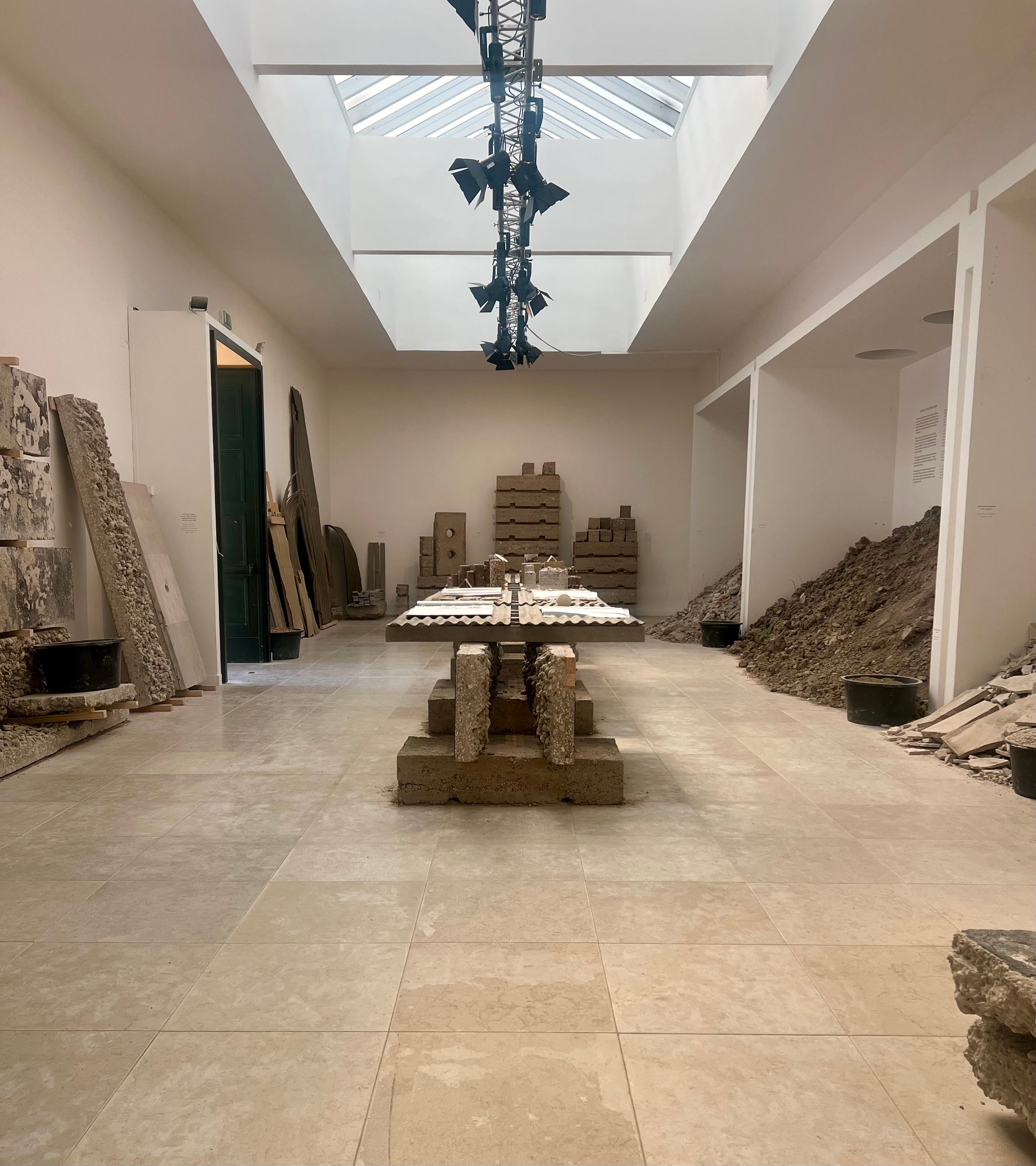
The Danish pavilion by Pihlmann Architects offers a strong answer to the "how." It challenges the very format of the Biennale. It turns inward and works with what already exists—not just thematically but physically. Instead of constructing a temporary exhibition in a permanent space, it does the opposite: transforming the temporary into something permanent. It activates the pavilion itself as an architectural device and turns maintenance into method and reflection.
A sensory, site-specific process where maintenance becomes architecture, and new potential arises in what is already present. A quiet but persistent rebellion that doesn't stage a new narrative but seeks to open the space of possibilities and answer: how do we create value with what is already there? And how does architecture become part of the solution?
The German pavilion takes a different approach. It uses the Biennale format with a clarity that shows what it can do when shaped with both form and narrative. Here, architecture serves as a framework to activate aesthetics—not as ornamentation but as a tool to convey a story about climate, society, and the necessity of action that both moves and mobilizes. It tells us why we need to act now. The result is an experience that gives goosebumps.
In this way, the two pavilions also serve as a reminder of something we in Denmark often take for granted: we already have the language for "why"—and precisely because of that, we have the freedom to work with "how." But that's not the case everywhere. Therefore, both positions are necessary. The Danish and German pavilions don't represent opposites but different prerequisites—and two sides of the conversation we can no longer afford to postpone.
What is also common to both is that they use architecture to activate aesthetics—not as decoration but as a means. One challenges the frame. The other uses it strategically. And precisely in this tension, the two pavilions offer what is missing in parts of Carlo Ratti's curated exhibition in the Arsenale: architecture with purpose and aesthetics with consequence. Not as ideals but as concrete approaches. And perhaps that's why the two pavilions stand out so strongly in Venice: because they dare to take responsibility. Because they choose necessity over novelty and remind us of what architecture should and can do when rooted in its core competencies and evaluated on quality, not novelty.
Unfortunately, this stands in stark contrast to much of the Arsenale, where material fixation, an endless array of posters, and technological optimism fill the space but rarely connect to something deeper. There's experimentation but rarely with purpose. Possibilities are shown, but few questions are asked. And perhaps that's where the crisis is felt most acutely: when professionalism is reduced to the superficial, and novelty is allowed to replace necessity.
For the Arsenale appears, for better or worse, as a snapshot of where architecture and design stand today: full of energy, curiosity, and material experiments—often accompanied by technological optimism but lacking direction, core, and architectural gravity. Much of what we see reveals a fundamental problem of our time: that novelty in itself is considered valuable. As if being first with a material, a technology, a form automatically creates value. But it doesn't.
So what this year's Arsenale inadvertently shows us is also what happens when architecture displaces its core: craftsmanship, function, and the ability to care. There's plenty of inspiration to be found in Venice. Just take the Arsenale building itself: a physical manifestation of the architectural heritage and intelligence that existed long before industrialization. It shows the potential in the site-specific, the sustainable, and the well-crafted—when we care about craftsmanship and the symbiosis between form and function.
Many of the experimental materials in the Arsenale spark curiosity but lack resonance. Why do fungus-based materials still resemble dirty underwear? Why do we try to convince ourselves that stones are alive instead of just letting them be what they are? Material choices must make sense—culturally, spatially, and sensually. That coherence is what we're losing. And without roots, rebellion never takes shape.
To care.
As explored in my book Danish Design heritage & Global Sustainability Danish design has long been rooted in this: the ability to care in Danish “at kere sig”. A form, a colour, a material – all consciously chosen, with function and user value in mind. To care is to take responsibility. It is not a soft value, but a demanding one. In Denmark, to care carries with it an ethical obligation – toward materials, people, and the collective. It is an ethic, not a style. To care is not perfection. It is presence.
Will it be enough? Of course not. But the ability to ask questions – and to reject structures as they are – is a place to begin. Perhaps the Biennale is beginning to let the first cracks open, where light from a new paradigm can filter through.
This year, the Biennale honoured Donna Haraway with a lifetime achievement award. What if she were given the chance to curate the Arsenale in 2027? That would be interesting. And it would strengthen the hope that the Biennale can still be a place where new structures are not only exhibited – but made possible.
The Danish Pavilion shows what Denmark can – and must – be for Europe: a nation that demonstrates how we realise the transition. It offers a response that is quiet, precise, and grounded – and all the more powerful because of it.
Not a concept. Not a promise. But a practice.
And perhaps that is what we need most. Not just to imagine a new paradigm – but to begin tangibly shaping it.